Resorbables.comStrategic enquiries ↗
Resorbables.com · Available for strategic acquisitionEnquire ↗

MATERIALS & CHEMISTRY

Collagen & natural biomaterials

Natural origin does not equal automatic biocompatibility.

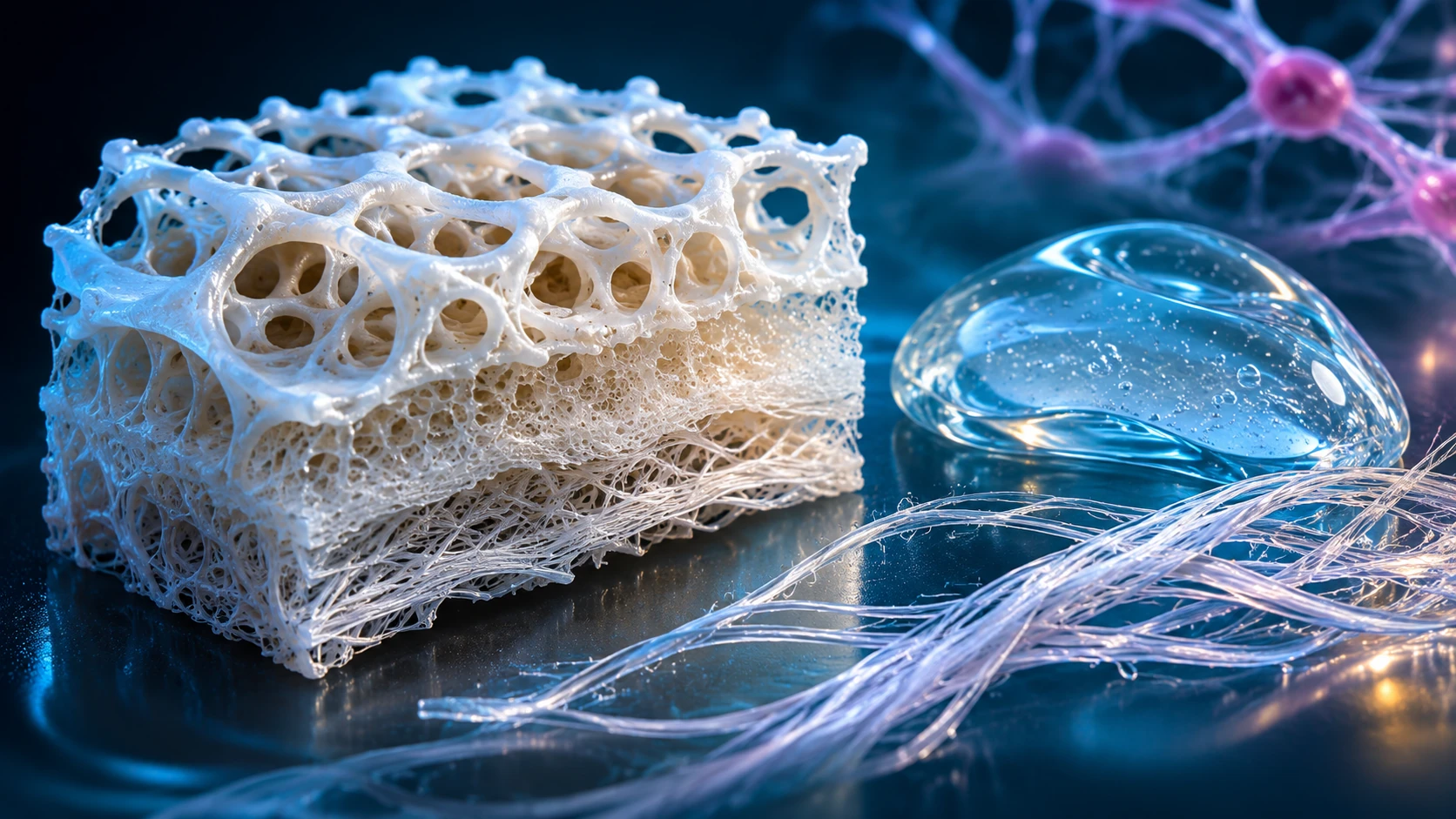
Original editorial visualization of Collagen & natural biomaterials

DIRECT ANSWER

What does this technology do?

Collagen, gelatin, chitosan, alginate and other biological or bio-derived materials are used or investigated for temporary tissue-contact systems. They can provide structures reminiscent of extracellular matrices, yet source purity and processing strongly affect results.

Current contextEstablished niches and active research

Important engineering variables

  • material formulation and controlled degradation
  • mechanical and biological performance
  • quality systems and device translation

WORKING PRINCIPLES

Materials in motion.

Enzymatic breakdown, hydrolysis, crosslinking and local biological conditions influence degradation. Manufacturing can produce sponges, films, membranes or hydrogels with very different mechanical behavior and lifetime.

TRANSLATIONAL REALITY

Where evidence matters.

Material origin alone cannot establish absence of immune reactions, allergenicity or infection risk. Product-specific biological evaluation and sterilization compatibility are essential.

DESIGN CONSTRAINTS

The details decide the outcome.

Engineering consideration

Source and purification define important safety variables.

Engineering consideration

Crosslinking can improve durability but alter biological response.

Engineering consideration

Hydration and sterilization can change handling and mechanics.

DIRECT ANSWERS

Questions worth asking.

Is collagen resorbable?

Certain collagen-based medical matrices are designed to degrade and be remodeled or absorbed, depending on processing and use.

Are all natural biomaterials safer than synthetic polymers?

No. Safety depends on the formulation, exposure and device-specific evidence.

REFERENCES

Traceable context.

Selected primary records and peer-reviewed literature relevant to the exact material or application.